
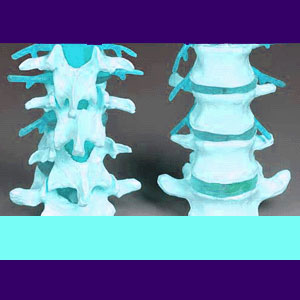
Being diagnosed with a degenerated disc should be no surprise at all. It should be far more surprising to only be diagnosed with just one. People write to us virtually every day complaining that they have pain which was blamed on a degenerated spinal disc. While this event is possible in extremely rare instances, the majority of these diagnoses are questionable. In fact, the culprit, degenerative disc disease is not a disease at all, but merely a normal part of the aging process which affects every organic tissue in our bodies.
This article will help clarify the truths of the intervertebral deterioration processes and provide some insight as to why the diagnosis is made so frequently and illogically.
Degenerated Spinal Disc Explanation
Disc degeneration describes a general wearing out of the intervertebral disc structures. This process occurs most notably in the lumbar spine and cervical spine, since these are the regions which get the most abuse during our lifetimes.
Degeneration means that the disc loses height, mass and circumference and may even develop a defect in the outer wall called an annular tear. While these circumstances sound bad, they are actually generally asymptomatic and will typically go completely unnoticed by the affected individual. However, if the person has coincidental back or neck symptoms, there is a strong possibility that the disc desiccation might be wholly or partially blamed for enacting the pain.

Degenerated Disc Processes
Disc degeneration is certainly not a condition of the elderly, as the name implies. Most people have moderate disc degeneration in the lower back and necks by the age of 30. Many people experience the same advanced degeneration by age 20. I was diagnosed with DDD at the tender age of 16.
Disc degeneration is one of the great scapegoats of the back pain industry. When there is back ache, it is very easy for any doctor to blame the symptoms on degeneration, since this is a universal process and is sure to be found in the spines of virtually every living adult human.
In essence, degeneration is old reliable when it comes to finding a spinal abnormality to take the fall for causing symptoms. It is almost comical that in many cases, the same symptoms blamed on degenerative disc disease are far too wide ranging to possibly be enacted by this normal aging process. In many cases, pain exists above the affected level or on the opposite side as the imaged degeneration. In some instances, it is quite illogical how DDD could have any credibility as a diagnosis at all.
Degenerated Disc Diagnostic Conclusions
If you have been diagnosed with DDD as the primary or only source of a painful back condition, I urge you to reconsider this diagnosis carefully. Get a second opinion from a different care provider at the very least.
Degenerative disc disease is typically no more of a problem than any other physical sign of getting older, such as wrinkles in the skin or graying of the hair. It is no surprise that back pain treatments designed to deal with DDD perform so poorly in their curative statistics. This is because DDD is rarely the real reason for any significant or chronic back pain.
My advice is to research spinal degeneration carefully and learn the objective facts. If you can not find relief from your seemingly degenerative-induced pain, you might have just been pursuing treatment for the wrong causation all along. You are certainly not alone in this mess, as many patients learn these truths too late, after already wasting time and money pursuing therapy, and possibly surgery, for what amounts to normal spinal aging.