
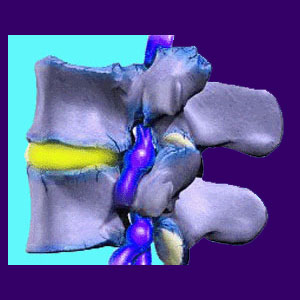
The rare instances of pain that is caused directly by disc degeneration are sourced from several possible causations. Aging causes discs to dehydrate, as well as their natural inherent ability to remain hydrated. Add to this the incidence of spinal injury and excessive wear often associated with many work-related and athletic exertions and discs might desiccate even quicker.
Doctors know that intervertebral degeneration is universally found in all adults, but many still continue to damn this natural process as a source of back pain, despite their being absolutely no evidence that disc aging has any definitive link to the origin of painful dorsal syndromes.
This article will examine and critique many of the accepted mechanisms of degenerative disc-related symptoms in the back and neck. If you are worried about disc degeneration that was diagnosed in your spine, this dialog should put your mind at ease.
Disc Degeneration and Chemical Irritation
Proteins in the disc sometimes leak out as the disc dries and shrinks. This process is called chemical radiculitis. There is moderate medical support for the idea that these proteins might irritate the surrounding spinal nerve roots. Is it possible? Sure. Is it likely? Maybe.
Far too many of us have this condition and do not show any symptoms. Remember also that degenerated discs contain less nucleus pulposus material and therefore, less irritating proteins to begin with. The explanation which makes the most sense in CR cases is that some patients may demonstrate a natural sensitivity to a chemical in the disc proteins, called TNF-Alpha. This might explain why a few patients suffer pain from leaking disc proteins, while most will not.

Degeneration Causing Arthritis
Another speculative cause of disc pain makes much more sense. When the disc shrinks down, the outer disc walls no longer extend to the edges of the vertebrae. This allows for less cushioning and possible incidences of bone to bone contact. Over time, this may cause bone spurs and increase the general effects of arthritis in the spine.
Depending on a person’s individual anatomy, the disc may or may not still cushion the vertebrae enough to prevent symptoms. This might explain why most people do not suffer considerable pain, but some do.
Disc Degeneration Facts
Most people who suffer with diagnosed degenerative disc disease symptoms are in their 30s. The majority of symptomatic people actually feel better as they get older.
Supposing… Leaking proteins cause nerve root irritation and therefore pain. The theory is that by the time we are in our 50s to 60s, the proteins are all gone and the pain begins to fade. Meanwhile, if bone spurs and arthritis are the cause, the theory is that the area has built up enough bone spur formation to actually stabilize it. Either theory might make sense, but I am not convinced.
However, either of these explanations makes more sense than the theory that disc desiccation is a painful process unto itself. This is completely illogical, since degeneration ensues for life, but pain in association with spinal aging typically falls off drastically after the age of 60 or so.
Generally, the spinal aging processes are benign and not inherently symptomatic for most people according to the latest clinical research.
Degenerated Disc Information
Doctors have a difficult time removing themselves from the structural theory of spinal pain which has been so ingrained in the treatment sector for decades. With the development of spinal imaging, the back pain industry really took off. The diversity of diagnoses grew year over year as new spinal degenerative patterns were recognized.

If something looked unusual in the spinal anatomy, it was assumed to be a source of pain, even if the reported symptoms did not seem to correlate to it at all. This was usually the case with disc degeneration. Unfortunately, this antiquated mindset is still embraced by many doctors, despite overwhelming evidence that the vast majority of back ache complaints are not sourced by spinal structural abnormalities. Of course, when an industry has created so many profitable treatments based on structural findings in the spine, it will not easily give up its paycheck.
Progress is being made slowly, but far too slowly for most diagnosed patients who are suffering right now. The best doctors have been calling for drastic overhauls in the diagnostic and treatment sectors for years already. Finally, these voices are beginning to receive the attention they deserve. I credit this mostly to internet propagation of the truths of spinal pathologies which were only for privileged medical ears only up until this past decade or so.
Progress is a very good thing indeed. Now if the medical sector would simply catch up with the rest of us, we would all be better off.