
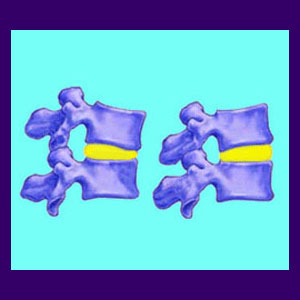
The facet joints are the areas of each individual spinal bone which connect the vertebrae together. These joints are also called zygapophysial joints or apophyseal joints. These articulated spinal joints are an evolutionary wonder which help to provide our spines with both structural integrity, as well as amazing flexibility. However, like all anatomical joints, the facet connectors can suffer injury and degeneration, leading to potentially painful back and neck problems.
This article delves into the structure and purpose of the spinal zygapophysial joints. We will focus on how age and physical activity degenerates these spinal joints and the consequences these changes might entail.
Spinal Joint Design
The vertebral body is the flat piece of bone which gives the spine its structure and weight bearing capacity. Projecting out from the rear of the vertebral body are dual spinal joints. These consist of the superior articular facet, which projects upwards, and the inferior articular facet, which projects downwards. These joints link to the vertebrae above and below to provide a flexible yet strong connection between the spinal bones.
Spinal joints allow front-to-back and side-to-side motion. The various soft tissues of the spine also help to hold these bonds tight and secure.

Facet Joint Protection
Each spinal joint is encapsulated in protective tissue which helps to lubricate the joint and allows for smooth and frictionless movement. This protective capsule contains synovial fluid which keeps the joint moving without friction or abrasion. The actual surfaces of the bones are coated with cartilage which also helps to protect the joints from wear and tear.
As with all the spinal structures, age, time, and wear will deteriorate these protective measures. This is when the facet structures are often implicated in causing or contributing to the incidence of back or neck pain.
Facet Joint Degeneration
Spinal joints suffer from the same degenerative processes as the rest of our bones and joints. The most common forms of spinal joint degeneration are arthritic changes leading to the loss of protective cartilage, reduction in lubricating synovial fluid and increased bone on bone contact which often produces bone spurs, also called osteophytes.
Additional information on the causes, symptoms and treatments for spinal joint pain can be found in my section devoted to facet syndrome.
Spinal Joint Facts
Spinal joints are well designed. They have evolved over countless generations to serve us well and provide us with a proper balance of support, structure, flexibility and strength. Recently, modern medicine has concluded that the completely normal degenerative processes that occur in these joints are to blame for many cases of back pain. In some cases, this is true and patients will develop some discomfort from their substantial spinal degeneration. This is usually the case when a particularly bad osteophyte forms in the path of joint movement or if the overall deterioration becomes so severe as to affect the actual stability of the joint.

In many patients, the small nerves which innervate the facet structures are implicated in being the source of pain, usually due to physical compression. However, most patients diagnosed as such almost always demonstrate symptoms which are illogically wide and severe to ever be caused by such small nerves.
Remember, there is no correlation between the occurrence of typical facet degeneration and the expression of back or neck pain. Many people have serious deterioration but no symptoms, while others have well preserved facet structures, but still have intractable pain.