
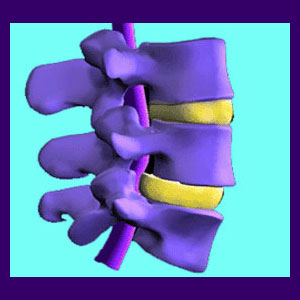
The neural foramen (also sometimes called neuroforamen) are the openings between the individual vertebrae, through which the spinal nerve roots branch off and exit the spinal cord or cauda equina. These natural vertebral passages are kept in place by the intervertebral discs. When the spinal discs degenerate, the nerve passageways often narrow, sometimes causing painful pinched nerve symptoms. It must be understood that the foraminal openings are far larger than needed for the nerve to exit successfully. Even moderate degrees of foraminal stenotic change should not impact the viability of the nerve structure. In order for a true compressive neuropathy to occur, virtually the entire opening would have to be blocked.
This discussion concentrates on explaining the existence and function of the neuroforaminal spaces in the spinal anatomy.
Foramen Degeneration
Besides disc degeneration causing a decreased foraminal space, spinal arthritic processes can enact changes in the actual vertebral bones, also creating the possibility for pain.
Bone spurs might obstruct the foraminal openings, preventing proper nerve signal. However, this occurrence is normal and is diagnosed far more often than it typically occurs in symptomatic form.
Additional sources of foraminal stenosis include abnormal spinal curvatures, such as scoliosis, hyperlordosis and hyperkyphosis, as well as vertebral slippage, such as anterolisthesis and retrolisthesis.

Foraminal Stenosis
Foraminal stenosis describes a condition in which the patency of the neural openings is diminished. In severe forms, this can cause pain which comes from nerve roots being pinched by a constricted neuroforaminal space. Foraminal stenosis symptoms are created in the nerve roots, just after they branch off the spinal cord, causing specific painful conditions in the areas of the anatomy served by the affected neurological structures.
Spinal stenosis is a condition which describes compression of the actual spinal cord or the cauda equina in the central canal space and should not be confused with a narrowed foraminal space. Spinal stenosis is usually a far worse and more functionally affective condition, since the neurological tissue affected influences a much larger area of the anatomy.
Understanding the Spinal Foraminal Openings
Although foraminal stenosis can indeed occur and might become a big problem for some patients, it is rarely a symptomatic condition. Disc degeneration and vertebral degeneration are normal and expected parts of the aging process and rarely cause any significant pain. These conditions often exist in adults without causing any discomfort at all.
Many patients receive a diagnosis of foraminal stenosis when their back pain might actually be from a completely different source. In these cases, the condition has been misdiagnosed and subsequent treatment is almost bound to fail miserably. Remember, even when a pinched nerve actually exists, it is statistically unlikely to create chronic pain. Instead, the compression will disrupt the nerve’s ability to transmit messages and the result will be objective numbness in the target destination served by the pinched neurological structure.