
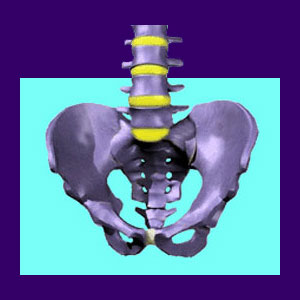
A fractured coccyx can be a very painful acute or chronic ordeal which can be blindingly symptomatic and may not resolve for a very long duration. Furthermore, due to the nature of the coccyx structure, many tailbone fractures are not immediately diagnosed. Although often thought to be one solid piece of bone, the coccyx can be composed of several sections of 2 or more bones each. This segmented anatomy can conceal minor fractures occurring at natural bone faults and make positive diagnosis of a break difficult without prior imaging studies available.
This essay details the usual causes and treatments for broken tailbones.
Causes of a Fractured Coccyx
The tailbone is a delicate and oddly-placed structure in some patients. Although tucked away in most people, it is more prominent in others. A prominent coccyx can make injury more likely, especially if the coccyx protrudes slightly away from the natural curve of the spine (towards the posterior plane of the anatomy).
Minor falls and trauma to the tailbone can result in bruising and severe force can inflict a hairline crack or simple fracture.
Hairline cracks can appear anywhere in the tailbone, but often form at the coccyx tip or at the fused natural seams of the coccygeal vertebrae.
A simple fracture can also occur at the vertebral seams, or at any location, if the force is sufficient. Sometimes patients with natural coccyx segmentation are diagnosed with simple fractures, although for them the multi-piece tailbone is a natural congenital condition.
Childbirth can cause coccyx pain, but is rarely responsible for actually breaking the tailbone. The possibility exists, but more often, birth-related coccyx pain is the result of bruising, rather than fracture.

Treatment for a Fractured Coccyx
Most broken tailbone injuries will heal on their own, although many will take an agonizingly long time to do so. Even full simple fractures are most commonly treated conservatively, since the coccyx has little use and rarely needs to be surgically corrected.
Coccyx repair surgery may be indicated for complex fractures involving surrounding tissue damage or compound fractures where the bone might break through the skin. These cases are rare and represent the gross exception to the normally experienced minor cracks seen in most tailbone fractures.
Coccyx removal surgery can be a treatment for a badly damaged coccyx, but is more often used for patients with long-term chronic coccyx pain conditions.
Coccyx Fracture Guidance
Once coccyx damage has occurred, there is little else to do but wait and heal. Coccyx injuries can take months to heal and up to a year to really feel normal again. Be sure to speak to your doctor to make sure the tailbone will not be left in a compromised state which may lead to further injuries or fractures in the future. Sometimes, a manipulative closed fracture reduction can be done to reset a misplaced bone in position. Other times, open surgical reduction is indicated for migratory bone fragments or vertebral segments.
Most of all, be careful with your coccyx. It is truly a painful structure to injure and is not an easy recovery process to endure.