
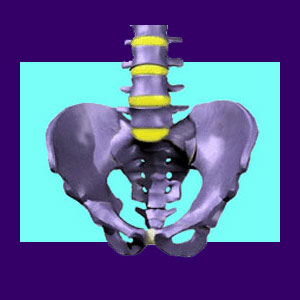
The lumbosacral spine has the dubious distinction of being the area most involved in the wide variety of back pain conditions suffered by patients worldwide. Lower back pain is a true misery to endure and the agony is usually linked to some structural abnormality in the lumbar or lumbosacral region of the human spine. While pain can definitely occur due to some of these structural issues, many mild to moderate conditions are merely coincidental to the symptomatic expression and take the blame needlessly, since they are not causative, but instead completely normal, expected and universal manifestations of spinal aging.
It should be noted that this area of the spine does endure the most degeneration compared to any other intervertebral levels. In some cases, truly extreme degenerative or injurious changes here can enact powerful and even disabling symptoms.
This study details the frontier region between the lumbar and sacral spinal zones.
Where is the Lumbosacral Spine?
The lumbar spine usually consists of 5 vertebral levels named L1 through L5. The sacrum consists of a fused section of triangular bone which joins under the last lumbar vertebrae and ends at the coccyx. The place where the lumbar spine meets the sacral spine is called the lumbosacral junction or juncture.
Occasionally, there exists what is known as a transitional vertebra at the lumbosacral juncture, labeled L6. As with most structural irregularities, this is sometimes pronounced as the potential source of pain, despite ongoing research which proves otherwise.
There may also be one or more sacralized vertebra at the lumbosacral frontier, which can also be implicated as the source of low back ache in some patients, often without evidence or merit.

Lumbosacral Spine Degeneration
Spinal degeneration is most marked in the lumbosacral juncture in the vast majority of people, regardless of whether or not they have any expression of back pain. In adults, it is normal to demonstrate degenerative disc disease, also known as disc desiccation, throughout the lumbar levels, but particularly at L4/L5 and L5/S1.
It is also very common to have bulging or herniated discs at these same levels. Most of these conditions are completely asymptomatic and exist in many patients who do not have, nor will ever have, lower back pain.
Osteoarthritis in the spine is also virtually universal with endplate changes, facet joint changes and other manifestations, such as bone spurs and foraminal narrowing, taking place in almost every adult vertebral column to one degree or another.
Other structural findings are also common in the lower lumbar spine, including most cases of spondylolisthesis and many cases of scoliosis, as well as front to back spinal curvature issues involving hypolordosis or hyperlordosis.
Lumbosacral Study
The lumbar sacral spinal juncture suffers a tremendous amount of wear and tear as we live, since it is the area which must move constantly and provide much of the support and work effort for our most vigorous physical exertions. This may be considered an inherent design flaw by some, but millions of years of evolution are hard to argue with. The design developed for a reason and over those countless millennia, back pain was not a big problem like it is today, despite the same degenerative processes taking place generation after generation.
This makes one think that the modern back pain epidemic is not the result of spinal aging at the lumbosacral junction, but is instead just the latest and greatest mindbody health issue of our time, eventually to be replaced by another condition, once the truth of the generally non-structural nature of many cases of back ache is universally accepted.