
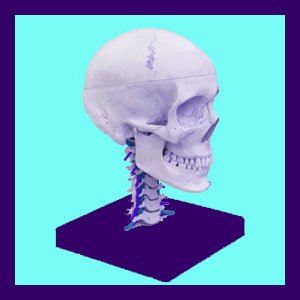
Military neck is layman’s terminology for a straightening of the normal lordotic cervical curvature. This relatively common condition is often used as a scapegoat on which to blame cases of idiopathic neck pain. Mild to moderate reduced lordotic curves are seldom problematic and rarely cause any significant pain or nerve symptoms. Extreme examples of cervical lordotic loss can be symptomatic and may require appropriate treatment.
It is vital to remember that many straight neck expressions are often caused by some other underlying symptomatic process. The muscles of the neck and upper back get very tight and exert force on the spine. When neck spasms occur, this force will be even greater. These soft tissue interactions can pull the spine taut, minimizing the curvature of the affected region. When this entire process occurs, the decreased lordosis is actually a result of a greater source process rather than a condition unto itself.
This essay explores the occurrence of straight spine syndrome in the neck.
Military Neck Causation
There are a variety of reasons to experience a loss of cervical spinal curvature. Some cases of this condition have congenital origins and make the patient disposed to developing a straight neck as they grow. Other cases of straight neck might develop as a result of a degenerative process, a back injury or the side effect of a prior spinal fusion surgery in a nearby vertebral level. Bad posture can also contribute to lordotic straightening in the cervical region.
As mentioned above, the lordotic change may be transient and caused by a muscular process in lieu of a structural skeletal one. In these instances, the only logical course of treatment is to diagnose why the muscles are chronically tight and resolve this mechanism. Failure to accomplish this goal will result in horrible treatment results.

Straight Neck Terminology
There are several interchangeable terms used to describe the loss of cervical spinal lordosis. Straight neck and flat neck are appropriate and logical terms used to describe cervical spinal straightening. Rigid neck is sometimes used, although this term can be misconstrued as a muscular problem.
Loss of cervical lordosis, reduction of cervical lordosis and cervical lordotic loss are all common medical terminologies for this same condition. Additional information concerning exaggerated or reduced lordotic and kyphotic spinal curvatures can be found in our full lordosis resource section.
Military Neck Experiences
Most straight neck syndromes are nothing to worry about. Although the cervical spine is designed to curve in order to support the weight and movement of the head, it is not inherently problematic to lose some of this natural curvature. Most diagnosed patients display mild to moderate cervical straightening which is almost never to blame for inducing chronic neck pain.
I was diagnosed with a straight neck years ago and always thought that it was a contributor to my back pain condition. With time and many failed medical treatments, I discovered that there were some very good reasons for my lordotic loss. Every single disc in my neck is herniated, as well as the first 4 in my upper back. Compound this with degeneration of the cervical vertebrae due to arthritic activity, and a predisposition towards muscular neck and back pain, and there are the logical reasons in my case. All this being said, I still feel that the main contributor to my neck symptoms is certainly muscular tensioning of the lordosis in both the neck and lower back. This explains why the condition worsens and resolves (at least to some degree) regularly.