
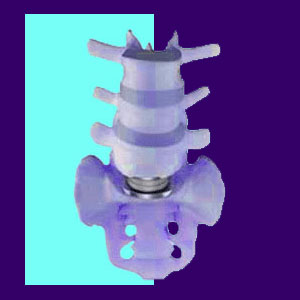
Spinal implants come in many styles and are used to treat a variety of painful conditions in the back. Implant technologies have become a hot item in the back pain industry ever since the relative success of artificial disc replacement surgery. Currently, there are dozens of different implantation devices either on the market already or in clinical trials.
Most implants used in the spine are designed for one of several possible goals: The first is to stabilize and assist fusions to bond strong and last long. These types of implants may be permanent or can be removable once the fusion naturally heals. The second type of implant is an artificial disc or synthetic disc nucleus, which will replace a damaged or worn out organic disc structure. Finally, there are a wide array of implants which deal with maintaining spinal alignment and vertebral spacing. These typically are used to prevent bone on bone contact, stenosis of the central canal or foraminal spaces and/or various types of arthritic expressions.
Coflex and X-Stop Spinal Implants
The Coflex device is made by Paradigm Spine LLC and is marketed to patients suffering from spinal stenosis and foraminal stenosis. The device is surgically implanted into the back and is placed between the spinous processes. Coflex is designed to create additional space between the vertebrae and enlarge the foramen, promoting decreased constriction of nerve roots which branch off the spinal cord or cauda equina and exit between the vertebral bones.
The X-Stop device is manufactured by Medtronic. This implant is also placed between the spinous processes to enlarge foraminal openings and relieve the symptoms of central canal and neuroforaminal narrowing.
Wallis System Spinal Implant
The Wallis System is made by Abbott Spine, along with many other implantation products. Wallis is a spinal fusion alternative used to reinforce vertebral segments which have demonstrated instability from advanced cases of degenerative disc disease, although many other conditions might eventually be treated with this method.

Additional vertebral implant products by Abbott Spine include the TraXis vertebral body replacement and a range of spinal spacers including the Cadence, InFix, Fidji, Fortitude Osso and Fortitude Duo.
HydraFlex Nucleus Arthroplasty System
The HydraFlex System is manufactured by Raymedica and is used to replace damaged intervertebral disc nuclei caused by degenerative disc disease. This technique creates a new disc nucleus with a synthetic moisture rich core which mimics organic disc structure and function. The goal of the procedure is to maintain spinal flexibility and prevent the need for spinal fusion surgery.
This device represents an additional leap forward in artificial disc technology. There are many other types of artificial nuclei in development, since this type of surgery holds much promise compared to full disc replacement.
Spinal Implant Benefits and Drawbacks
Most modern implant technologies are being developed to alter traditional spinal surgery techniques and hopefully improve curative statistics. Traditional back surgery rarely completely cures the symptoms in the majority of treated patients and often leaves a postoperative individual with permanent reduction in functionality and possibly even total disability. Many patients are far worse after having open spinal surgery than before.
Back surgery is often so poorly conceived and executed that it actually has a legitimate disorder named for its dismal treatment results… failed back surgery syndrome.
Most implant devices are designed to maintain spinal function and flexibility. This is a complete reversal in theory from traditional fusion techniques. The spine is designed to bend and flex, so any implant which helps to relieve symptoms while maintaining range of motion is at least on the right track.
Vertebral Implants In Use
I have witnessed very few miraculous cures from any type of surgical intervention among back pain patients. I have received countless letters from patients who suffered through invasive surgeries and still have pain. Many of these poor souls desperately regret their decision to go under the knife. Some were completely ruined by their operations and now must live with irreparable damage to their spinal bones, nerves and muscles. I am very anti-surgery for a good reason indeed.
Nevertheless, back surgery is still indicated in some patients as a last resort option. For these patients, I am happy to see the technology being developed which will allow surgical correction followed by the return to normal spinal function, rather than considerable and lasting restriction of activity.

Spinal implants offer a new idea in surgical treatment of many potentially symptomatic conditions. Many devices are in clinical trials and show promise as an option for patients with a variety of problematic spinal abnormalities.
If you are a patient facing spinal surgery, you owe it to yourself to investigate all your options. While a specific surgical implant might not yet be available to cure you right now, it is likely to be in clinical trials somewhere in the world.
If you can wait it out, there is a good chance that your long-term prognosis will be much improved when compared to a traditional surgical solution.
Better yet, try to find an effective non-surgical alternative solution and minimize your risks all together.