Understanding the basic spine anatomy is always an important consideration for any patient who has been diagnosed with a structural issue in their vertebral column which has been blamed for causing their suffering.
The spine is also called the vertebral column or spinal column. The spine is a stack of specialized bones extending from the skull to the pelvis. It is made up of 33 bones called vertebrae, in most people, with 24 being individual bones and 9 being grouped together; 5 to form the sacrum and 4 to form the coccyx.
The spine is designed to bear the weight of the body, absorb and distribute stresses placed on the anatomy, as well as provide protection for the spinal cord, spinal nerves and internal organs. It is the spine which truly gives us our human form and functional capacities.
This essay examines the individual regions of the spine and how they work together.
Spine Anatomy and Function
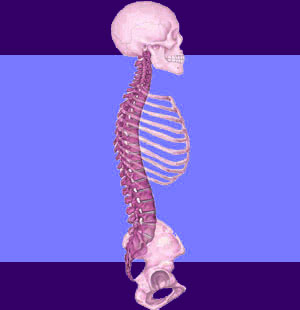
The spine is also a central attachment point for many other structures in the body. Ligaments, tendons and muscles all attach to the spine. The ribs also attach to the spine in the thoracic region. The bones in the spine are living tissue and help to produce red blood cells, as well as store important minerals needed by the body. The normal spine is curved in the shape of the letter S. This S curve helps a healthy spine act as a shock absorber and distribute stress evenly.
The cervical spine curves slightly inward, with the open end facing rearwards. This is called a lordotic curvature.
The thoracic spine curves outwards, with the open end facing the front of the body. This is called a kyphotic curvature.
The lumbar spine curves inward, once again demonstrating a lordotic curvature.
Finally, the sacrococcygeal region curves back outwards, expressing a kyphotic curvature.
It is common for a spinal problem to cause a change in this natural shape and possibly to enact pain. It is also possible for an increased spinal curvature to bring about agonizing symptoms in extreme cases.
Human Spine
The human spinal column is a miracle of design and functionality. It is one of the primary contributors to the success of our species. The spine is a rugged and durable anatomical structure which is designed to withstand all the demands placed upon it by normal life.
The spine has a bad reputation for a being a major source of chronic back pain and problems, but this reputation is largely undeserved. Most long-term pain syndromes have been proven to rarely correlate to spinal abnormalities, regardless of their specific nature.
In fact, research clearly shows that the incidence of the most common spinal irregularities, including conservative forms of disc herniation, disc degeneration, vertebral arthritis, spinal curvature and vertebral misalignment, does not directly correlate to the expression of back, neck or sciatica pain. Never assume that back pain is caused by the spine without definitive proof of pathology. Most abnormalities of the spine are scapegoats, rather than the actual origins of pain.