A straight back is a common term for a spine which has lost some degree of one or more of its natural front to back curves. This condition can range from minor to extreme and from and asymptomatic to problematic. It is crucial for patients who are with a diagnosed straight spine to understand the facts of their condition in order to decide upon the best course of treatment. Make sure to always consult with your doctor to get an accurate prognosis for your straight spine condition. Remember to ask how much of the natural curvature has been lost and whether the condition is stable or still in flux.
This discussion helps patients to navigate the diagnostic process for hypolordotic and hypokyphotic conditions.
Straightened Back Definition
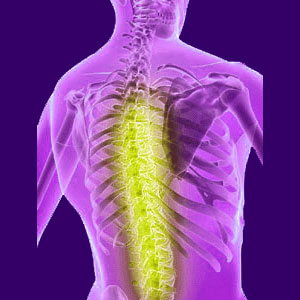
A normal healthy spine demonstrates a series of anterior-to-posterior curves designed to assist in bearing weight and reducing shock in the spinal column.
The lumbar region contains a lordotic curvature with the open end of the curve facing the posterior side of the body. The thoracic region contains a kyphotic curvature with the open end of the curve facing the anterior side of the body. The cervical region contains a lordotic curve with the open end of the curvature facing the posterior side of the body. This “S” shape is a marvelous design giving human beings unparalleled functionality and flexibility in a variety of tasks and positions.
A patient with a straightened back shows some degree of loss in one or more of these normal spinal curvatures. Patients may only demonstrate a single area affected by lordotic or kyphotic loss, or may experience multiple regions of decreased curvature.

Straight Back Condition
Most patients diagnosed with this condition demonstrate only a mild to moderate loss of one or more curves. The body is a marvel of adaptation and these patients rarely suffer any serious or even noticeable effects from their flat back conditions.
Patients with severe loss of a particular curve may experience no symptoms, minor to moderate symptoms or severe back pain symptoms, depending on numerous other criteria. Some instances of a straightened spine can be very troublesome and can lead to reduced functionality or even partial disability for the affected patient.
Patients with serious decreased curvatures may be a greater risk for spinal and foraminal stenosis, vertebral fracture and increased osteoarthritic activity. Many feel fragile and easily injured, even if they do not have chronic pain.
Straight Back Information
Additional information on the loss of spinal curvature, as well as exaggerated spinal curvature, can be found in our full lordosis section.
Many patients are diagnosed with the loss of a particular spinal curvature, including me. I have decreased lumbar lordosis, as well as decreased cervical lordosis. Many chiropractors and other therapists insisted that these factors were a primary contributor to why my pain never got any better. I believed them 100%, since I did not know any better. Looking back, I now realize that the diagnostic nocebo effect was the real reason why my symptoms worsened over time. I was basically told I would not get better and that most likely, I would get worse. This part was true, but it had nothing to do with the loss of any spinal curvature.

Much research has enlightened me to the fact that many cases of lost lordosis and kyphosis are not due to structural spinal issues at all. Instead, they are sourced from chronic or recurrent muscular spasms which literally extend the spine and cause it to lose its natural curvatures. I know this is a main cause of my own ongoing lordosis issues. While I have yet to find any relief from this suffering, at least it is better than knowing there is a definitive structural explanation for my decreased spinal curves. After all, where there is an idiopathic reason for a symptom to exist, there is always hope for a cure.