
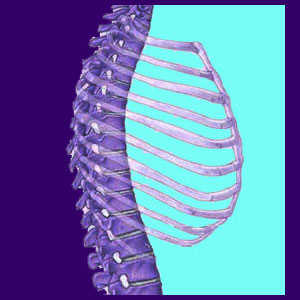
The thoracic spine is located between the cervical spine and the lumbar spine. This area is commonly called the mid back, middle back or upper back. The normal thoracic region demonstrates a definitive kyphotic curvature. The ribs connect to the thoracic area creating a protective cage for the internal organs. The thoracic region is comprised of 12 vertebrae named T1 through T12. The intervertebral discs in this area are slightly thinner than in the lumbar region, but thicker than in the cervical area.
The thoracic region is designed for stability and protection, not for individual vertebral level movement. There is less chance of injury, herniation or degeneration in the discs of the thoracic area. Likewise, the arthritic processes are also minimally active in the thoracic region, sparing the vertebral bones much of the deterioration found in the more mobile areas of the spine.
Injuries to the thoracic spine are usually caused by significant trauma, such as a car accident.
This treatise explains the form and function of the thoracic vertebral region of the backbone.
Thoracic Spine Details
The middle back shapes our torso and is not called upon to bend or flex as much or as often as the upper and lower ends of our spines. The upper back does work closely with the neck and is sometimes affected by pain syndromes in the lower cervical levels, especially at the cervicothoracic juncture.
Meanwhile, the lowest thoracic levels, and particularly the thoracolumbar juncture, might suffer some degenerative effects related to the lumbar spine.
The ribs do much to reinforce the thoracic region, adding a level of horizontal protection and support not enjoyed by any other spinal area. This bony cage is a great evolutionary design, since it encloses all of our internal organs in a well fortified organic framework.

Thoracic Pain Syndromes
Upper back muscle pain conditions are far more common than bone or disc injuries to the mid back area. Many of these might be experienced due to repetitive strain or may simply be caused from overwork.
Pain in between the shoulders is a common patient complaint, as are general upper back symptoms often linked to movement of the neck.
Atypical kyphosis is a thoracic-specific abnormal spinal curvature which can create pain in some instances. Hypokyphosis involves a loss of normal curvature and is usually a result of a muscular spasm issue, rather than being a condition unto itself. Meanwhile, hyperkyphosis might be minor or major, potentially enacting postural and functional difficulties in moderate to severe forms and even threatening the internal organs and ability to breathe in its most extreme expressions.
Spinal-induced nerve pain conditions are less common in the thoracic region, but still exist, particularly when the muscular tissues are suspected of causing either nerve or vascular tissue compression. These circumstances often affect nerve issues in the brachial plexus, such as in the diagnosis called thoracic outlet syndrome. Of all the spinal locations, the thoracic zone is blessed with the lowest reported incidence of pain and also demonstrates the lowest rate of all spinal abnormalities compared to the cervical or lumbar areas.