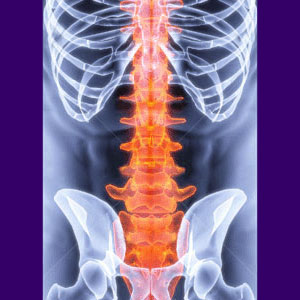
A straight spine is a common name for a condition in which the backbone loses a percentage of one or more of its normal curves. The spine is multiply curved back to front to allow greater weight bearing and shock negating qualities. A typical spine is curved in the shape of a letter S, when viewed from the side. The cervical and lumbar regions maintain a lordotic curve, with the open end of the curve towards the posterior. The thoracic spine maintains a kyphotic curve, with the open end of the curve towards the anterior. Partial loss of one or more of these normal curves is often blamed as the cause of painful symptoms throughout the back. This suspicion may be verified or unfounded, depending on many case-specific factors.
This essay investigates the functional effects enacted by a straightened vertebral column.
Straight Spine Causes
There are many structural reasons why a patient might lose spinal curvature.
Congenital conditions are a common cause of curvature loss. Some patients are simply either born with a lesser curved spine or the predisposition to develop it during their lifetimes.
Changes to lordosis or kyphosis in one spinal region can cause a straightening of curvatures in other spinal regions. Degenerative or postural changes can create the ideal circumstances for the minimizing of typical spinal curvatures.
Back injury can also produce a lessened curvature either in the direct area of trauma or in the surrounding spinal levels.
Finally, spinal fusion surgery can flatten out operated spinal levels or neighboring vertebral levels.

However, the single most common reason why a patient might express a decreased lordotic or kyphotic curvature is surely due to muscular reshaping of the spinal curves.
This temporary condition can be enacted by spasms or simply through chronic tightness in muscles which help regulate the vertebral column. For these patients, finding the source of the muscular issue will almost always result in a sudden and dramatic return of the lost curvature.
Straight Spine Symptomology
Expressions of flat spine conditions can be diverse and might mimic many other back pain symptom syndromes. Many doctors feel that any loss of curvature is a major source of discomfort, while others write it off as much to do about nothing.
Minimal to moderate loss of spinal curvature is rarely symptomatic, although it is often blamed for causing several types of back ache when no other more obvious cause is available. This sometimes makes a straightened spine one of the ever growing number of back pain scapegoat conditions.
Very severe spinal straightening can be a real problem for the patient and might create acute back pain symptoms or general sensitivity throughout the affected region or even the entire backbone. While this condition is rare, it is possible to experience and drastic treatment is usually the prescribed course of action.
Straight Vertebral Column Conclusions
This condition is an ongoing part of my personal diagnosis. In addition to my 12 herniated discs and degenerative disc disease, I was also diagnosed several times as having both a decreased lumbar curvature and a military neck (also called a straight neck condition). I used to blame these issues on my upbringing and having it drilled into my head to stand up straight. Martial arts training for all those years is akin to military training and keeps the student standing at attention for many long hours. Now I feel it is more a direct result of chronic muscular tension.

Some doctors thought that this condition was postural and others related it to my other spinal concerns. None of my doctors seemed to think this was my primary cause of pain, but most thought that it was a contributor. In the end, I still have no conclusive diagnosis as to the exact reasons for my former diverse symptoms. It can be very frustrating indeed.
Just remember that the spine is not such a delicate structure after all and some variation from the norm is often harmless and coincidental to any pain. Research has shown little correlation between minor lordotic and kyphotic reductions and the incidence of chronic back ache. In cases where they are related, the loss of curvature is likely to be more of a result of the pain rather than a cause of it.
Looking at it objectively, this is another example of which came first… the curvature change or the pain.