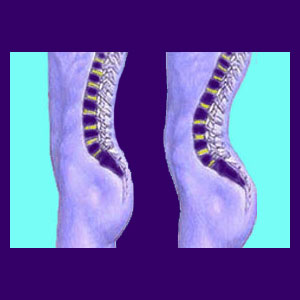
Lordosis describes the degree of front to back curvature in the neck and lower back. However, the name is also used as a diagnostic conclusion for an atypical curvature in either the lumbar or cervical spines of affected patients. Normal human lumbar and cervical regions demonstrate a particular degree of lordotic curvature, which means that the open side of the curve faces the rear of the body. These curves are necessary to help distribute weight and shock throughout the spinal column.
This resource section explains normal and abnormal versions of cervical and lumbar lordotic curvature.
Facts about Lordotic Curvature
In hyperlordotic patients, these curves are mildly or greatly exaggerated. Normally, this condition is not problematic and causes no pain or symptoms. However, severe lordotic curvatures can cause health concerns and should be monitored by a qualified physician. In contrast, the loss of lordotic spinal curve, also called a hypolordotic condition, can also be an issue, since the vertebral column is subjected to abnormal stresses.
Many patients come across the term loss of lordosis on their MRI reports, most commonly in the neck, but also prevalent in the lower back. The doctor will tell the patient that this means a decrease in normal spinal curvature, but will rarely elaborate to a meaningful degree. This often makes the patient feel very afraid, especially once they begin the research the condition and see that the curve should be greater than they now demonstrate.
In a great number of these cases where back or neck pain exists, there is actually no structural problem with the spinal curvature at all. Instead, the loss of the typical curve is due to the pull of painful, tight and/or spasming muscles in the vicinity. This is usually a transient condition, but can be ongoing especially when the pain is chronic. I have had this occurrence show up on my MRI reports since I was 16 and still do, decades later.

Lordotic Topics
Changes in the front-to-back curvature of the spine might be unfairly blamed for causing pain or may actually be pathological. Learn more about specific types of lordotic conditions in these informative essays:
Lordotic pain may occur due to hyper or hypo versions of the condition in the neck or in the lumbar spine. Lordosis back pain is generally demonstrated in the lower lumbar zone.
Military neck, also commonly called straight neck, describes overly straight posture due to a deficient cervical curvature.
A straight spine, also named a straight back or flat back, can entail a reduction in thoracic or lumbar curvature.
Lordotic straightening can occur in the cervical or lumbar spine, possibly eliciting symptoms in extreme cases or causing an increased propensity towards injury.
Sway back describes an exaggerated curve in the lumbar spinal region.
Lordotic curve treatment might begin with conservative care, but often escalates to surgical interventions for serious curvature issues.
Some degree of lumbar lordotic change and cervical lordotic change is normal to experience as we get older. These changes are not inherently painful or problematic.
Normal Lordosis
Normally, the lumbar and cervical spinal regions demonstrate a typical lordotic curve (convex in front and concave in the rear) In layman’s terms, this means that the closed side of the curve faces into the front of the body and the open side towards the rear. In hyperlordotic patients, this curve is deeper than usual, while in a hypolordotic patient, the curve is too shallow.
In a normal lordotic condition, shocks and stresses put upon the spine are evenly distributed, increasing spinal strength and the ability to absorb trauma. Changes in the normal curvature will affect these anatomical abilities to a lesser or greater extent, depending on the degree of increased or decreased curvature.
A multiply curved spine is one of the wonders of nature, since it is so much more efficient at providing strength, support and flexibility. An abnormal curve, be it permanent or temporary, can make a person feel odd, weak, stiff, off-balance and in pain. This is not a fun condition, even when it is quite innocent and caused by minor muscular issues.
What Causes Atypical Lordosis?
Many atypical lordotic curvatures are set in motion during the fetal development stage. This qualifies some cases of abnormal lordotic curvature as a congenital back pain condition. The most common reason for early irregular lordotic development is variations in the intervertebral disc height between the posterior and anterior sides.
To simplify once again, this means that the front and back of the discs are not the same thickness. This causes the individual vertebrae to tip slightly and increases or decreases the normal spinal curvature.

In atypical adult lordotic curvatures developed later in life, the chief causes are advanced spinal degeneration and arthritic changes. Back injury can also factor into this equation, since trauma can reshape the spine significantly. Finally, surgical spinal fusion can apply pressure to surrounding vertebral levels causing an increased or decreased lordotic effect.
The above are all permanent sources of increased or decreased lordotic curvature. As previously mentioned, the most common transient source is muscular spasm which literally pulls the bones from their normal placement, causing the loss (or sometimes gain) of usual curve profile.
Spinal Lordosis Conclusions
Most cases of hyperlordotic or hypolordotic curvature are nothing to be concerned about. Mild to moderate lordotic change is not uncommon and most patients will never suffer any related pain or discomfort, unless their curvatures (or lack of) are extreme. Make sure to remember this if you are diagnosed with lordotic change by your doctor. The nocebo effect of this diagnosis can be strong and will often be a catalyst for psychosomatic symptoms to begin.
Advanced lordotic change can be a serious health crisis and should be monitored closely. Typical treatment for extreme hyperlordotic change involves hardware-assisted spinal fusion, which in itself can be more of a problem than a solution. Talk to your doctor concerning all your options before agreeing to any one particular back pain treatment modality.