
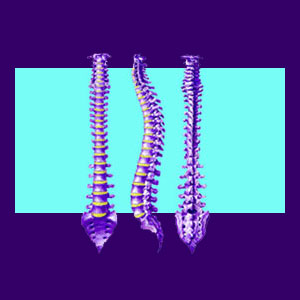
Front-to-back spinal curvature is a normal part of the human anatomy. However, sometimes individuals might demonstrate atypical curvatures which can cause potential health problems and even chronic back pain in rare instances. While most conservatively abnormal spinal curves are not harmful, it is always wise to get a thorough exam from a qualified physician and have your curvature monitored regularly.
This article will detail some of the more common irregular spinal curve conditions, but will focus on the irregular front-to-back curvature diagnoses. We will discuss scoliosis, lordosis, kyphosis and their many diagnostic variations.
Normal Spinal Curvature
The typical healthy human spine is curved in the shape of the letter S, when viewed from the side. The cervical region has a lordotic curve, as does the lumbar region. The thoracic area demonstrates a kyphotic curve, as does the sacrococcygeal region.
These curves are designed to distribute weight and force over the spinal structures and the anatomy as a whole. The typical spine should not have any side-to-side curves and should appear as a straight line when viewed directly from the front or the back.

Abnormal Spinal Curves
There are many reasons why a person might develop an abnormal curvature of the spine. Most of these mild expressions are asymptomatic, while others can mean big problems for the affected individual:
Congenital conditions, such as spina bifida often entail abnormal curvatures of the spinal column.
The various forms of scoliosis create abnormal side-to-side curvatures which are generally not painful or problematic in most people. However, advanced scoliosis can be a major health concern and should be actively monitored by a specialist.
Lordosis describes the degree of curvature in the lumbar or cervical spinal regions. Hyperlordosis is an exaggeration of the usual curvature, while hypolordosis is a reduction in the expected curvature in the same areas.
Kyphosis describes the degree of front-to-back curvature in the thoracic and sacrococcygeal regions. Hyperkyphosis is an exaggeration of the typical curve, while hypokyphosis is a condition in which the expected curvature is lacking.
All the irregular variations of lordosis and kyphosis can become significant health concerns if the curvature changes are extreme.
Lack of Spinal Curvature
Many patients, such as myself, demonstrate a lack or one of more typical spinal curves. This is usually apparent in the lumbar and/or cervical spinal regions, when the patient does not maintain a normal lordosis. This condition is usually noted on MRI reports as hypolordosis. This straight back or straight neck condition is often blamed for causing back ache, but is rarely the source of any significant or lasting discomfort.
Temporary loss of spinal curves can be caused by any back injury, since the affected muscles might actually tighten up to the extent of straightening the normal curvatures in the spine.
Curvature of the Spine
Very severe abnormal curvatures and loss of curvatures can spell big problems in rare instances. However, these events are the extreme exceptions to the rule and affect only a small percentage of individuals diagnosed with atypical curvatures. Most affected people have a harmless exaggerated spinal curve (or lack of a spinal curve) and should not expect any pain from their conditions.

That being said, atypical curves and lack of curves still act as common back pain scapegoats, although the diagnosis may be incorrect. In fact, many of these curvature changes are direct symptoms of another causative condition, not causes unto themselves.
If your pain has been blamed on a relatively minor curvature abnormality, I strongly advise you to get a second opinion on the source of your suffering. If you demonstrate severe or extreme versions of irregular curvature, symptoms might be expected and may be terribly severe. In these circumstances, expert care should always be rendered by a specialist in the particular condition displayed.