
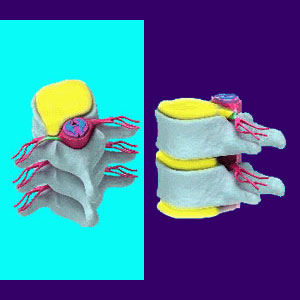
A spinal disc injury can result from concentrated trauma to any area of the back or can come about due to the normal degenerative processes combined with certain damaging circumstances.
Intervertebral discs are the shock absorbers of the spine. They help to cushion the vertebral bones and facilitate spinal movement. Back injury to a spinal disc can take the form of a bulge, herniation or rupture. Disc injuries are far more common than most people would believe. In fact, many people have herniated discs and do not even know it.
Acute injury to an intervertebral disc is typically painful, regardless of where in the anatomy it occurs. However, there is little evidence demonstrating the symptomatic nature of most disc abnormalities once the acute phase of injury has ended. In essence, most disc injuries should not cause chronic and enduring symptoms.
This essay details spinal intervertebral disc traumas and their resulting effects in back and neck pain syndromes.
Suffering a Recent Disc Injury
A traumatic event can cause a disc to herniate, bulging out from its normal spinal position. This bulge may or may not cause related neurological effects on the surrounding spinal nerve roots. In rare circumstances, the bulge might press directly into the spinal nerves causing serious complications, such as cauda equina syndrome.
In other scenarios, spinal stenosis may result from a central or paracentral disc herniation. If the stenosis is severe or if there are other contributing factors at the same level, symptoms may be elicited. However, most mild to moderate canal narrowing is not a health concern and should not produce pain or neurological dysfunction.
Most new disc injuries go unnoticed or simply cause minor back pain which may be interpreted, by the patient, as a pulled muscle or overexertion. Some injuries cause severe pain which might alarm a person enough to seek medical treatment.

The majority of all disc injuries will resolve all by themselves in a matter of weeks. Some may require conservative medical or complementary treatment, but will usually get better in the same time frame. It is very rare for a herniated disc to cause long-term, physically-motivated back pain. However, it is extremely common for a disc injury to unfairly take the blame for chronic back pain.
Spinal Disc Scapegoat
Back pain scapegoats are spinal conditions which are normal to experience and usually produce few or no actual symptoms, but are blamed for many continuing pain syndromes. Herniated discs are probably the most common of all spinal structural scapegoats.
The symptoms suffered by most patients who are diagnosed with chronic disc pain just do not make much clinical sense. Most of these people endure disc symptoms which are blamed on the extruded or bulging disc material causing a pinched nerve. Proven research has concluded that long-term compression of a nerve produces a lack of neurological signal, not pain. The result of this continued compression would be numbness, not the frequently blinding agony suffered by many patients.
It is clear that the overwhelming percentage of herniated disc conditions exist quite innocently and coincidentally to any pain. This fact has received even more support recently, when many medical associations revised diagnostic guidelines offered to their physician members. One of the major changes cautioned doctors not to assume any disc abnormality found during diagnostic imaging to be inherently symptomatic. The revision continues to say that there is no correlation between the incidence of herniations and the existence of back or neck pain.
My Experiences with Disc Injury
I suffered from lower back that was blamed on 2 herniated discs (L4/L5 and L5/S1) for many, many years. All of my doctors implicated these discs for causing the majority of my pain, although many figured my degenerative disc disease and minor scoliosis into the equation, as well, but I digress.
I also believed that these discs were the source of my suffering, since this was what I was told. I tried all the usual back pain treatments, except back surgery, yet found absolutely no substantial pain relief.

Worst of all, my symptoms steadily worsened and I almost became resolved to a life of progressive pain and eventual disability. Being a martial arts instructor and aficionado, this was about the most devastating fate I could imagine.
Well, I got tired of playing the poor helpless victim and decided to take action against my debilitating pain. I spent long hours reading and researching all about my back ache conditions. I learned so much and soon the hours turned to days, then weeks, then years. Along the way, I discovered that much of what I had thought to be true about herniated discs was merely myth. Some of this information was obviously provided to me for purely financial gain by a few of my caregivers.
I soon realized the most important aspect of medical care was not me, my health or my recovery… No, It was money. My money. My care was all about profit that could be made from my suffering, at my expense, for as long as I believed the lies.
Disc pain is rarely anything more than a temporary result of injury. Chronic disc pain is almost always misdiagnosed and may even be part of a larger psychological pain syndrome based upon repressed emotional issues and/or diagnostic nocebo effect. I urge all patients to learn the facts about herniated discs and other common types of intervertebral disc trauma. Once you know, your outlook on the nature of your own symptoms might change drastically, as mine has.