
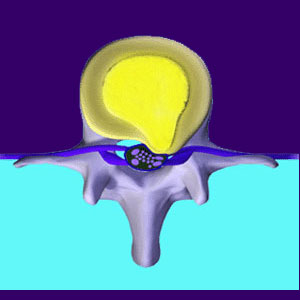
The nucleus pulposus describes the soft inner center material of the intervertebral disc. This nucleus is surrounded by and contained within the many protective layers of the annulus fibrosus. The nucleus of the disc is a wonder of design, creating a natural shock absorber in between each vertebral bone. The spinal discs help to cushion the body against trauma and also facilitate the incredible flexibility demonstrated by the human spine. Unfortunately, the nucleus is also the structure affected by desiccation, herniation and even spinal disc rupture.
This guide examines the process by which the intervertebral nucleus deteriorates with age and injury and the consequences these changes might produce on vertebral form and functionality.
Nucleus Pulposus Construction
The disc nucleus is made up of collagen fibers and a moisture rich polysaccharide gel. Much of the mass of the nucleus is water and this moisture content is in constant flux, both hour to hour and year by year.
Compression of the discs throughout the day will actually cause a person to become slightly shorter by nighttime, compared to when they woke up that morning. Relieving pressure off the discs helps to rehydrate them and restores lost disc height and fullness.
As we age, the disc naturally loses moisture permanently and will steadily become thinner and smaller in diameter. These alterations are called degenerative changes, but are completely normal and expected to experience as we get older.
These changes are rarely the cause of any pain, although degenerative disc disease is a common diagnostic scapegoat.

Spinal Disc Nucleus Herniation
If the outer disc wall is compromised, the inner nucleus will bulge to fill the space, creating an asymmetrical shape. This is also called a herniated disc.
These bulges can occur in the middle of the disc, or on either side, and are normally of no concern. Actually, bulging discs are very common and are found in many adults. They do not typically cause pain or any other troublesome symptoms.
If the outer disc wall rips or tears, the soft jelly nucleus material can bleed out of the disc, causing complete disintegration of the disc integrity. This situation is known as a ruptured disc. Believe it or not, this is also not usually a painful condition and many patients are not even aware of the herniated and ruptured discs in their spines.
Nucleus Pulposus Conclusions
It is possible to suffer pain from a problematic disc which affects either the spinal cord itself (spinal stenosis) or one of the spinal nerve roots (foraminal stenosis). These conditions are very common explanations for back pain, but are often misdiagnosed. This explains why many disc syndromes do not respond to even the most aggressive treatments.
Actual structural disc pain will usually go away all by itself, but if it continues, appropriate therapy, such as spinal decompression, will almost always cure the symptoms. Back surgery is not typically a good option for dealing with disc pain and demonstrates poor curative statistics.
If you have perpetual disc-related pain which has not healed, despite treatment, I advise you to consider the validity of the diagnosis and seek a second professional medical opinion, if you have not already done so.