
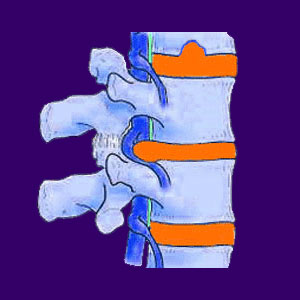
A Schmorl’s node is a combination vertebral/intervertebral abnormality wherein part of a spinal disc infiltrates through the attaching endplate and into the vertebrae above or below the disc. This occurrence is not entirely understood and many cases have been linked to a variety of possible causations. One thing is for sure: The simple existence of a Schmorl’s condition is not indicative of a spinal problem and is not inherently painful or problematic.
Most schmorl’s conditions are discovered when imaging the spine after an injury or as part of the diagnostic process to ascertain the underlying source of an existing back or neck pain complaint. Research shows no direct correlation between the presence of pain and the demonstration of nodes in the vertebral bones. It should be noted that most diagnosed cases are mild, although far more serious and invasive node formation can occur, possible compromising the integrity of the vertebral body.
This essay examines the relevance of vertebral node formation in back or neck pain sufferers.
What is a Schmorl’s Node?
Nodes occur when part of an intervertebral disc somehow winds up inside a cavity in an adjacent vertebral body. Whether the cavity is created due to force exerted by the disc or whether the disc simply fills an existing cavity is not always known. In some cases, infiltration is minor and cosmetic, while in other cases, the disc may reach far into the vertebral marrow and possibly cause inflammation, infection or even vertebral fracture.
The reasons why nodes occur are not completely known, but most doctors believe they can exist due to any number of the following possible explanations:
Congenital defects may cause a node to form before birth or during early development.
Dietary or nutritional deficiency resulting in low bone density issues can cause hollows in the vertebral bones which might become nodes.

Spinal injury to the disc or vertebrae can create nodes or hollows which may result in node formation.
Disease processes or tissue necrosis conditions can increase the risk for node formation.
Spinal Disc Node Formation
It is crucial to understand that many nodes present no danger and should simply be monitored for problematic changes in the future, rather than actively treated. For deep nodes which intercept the bone marrow, complications are more common and can be severe. In these cases, surgery is sometimes appropriate or even required to ensure general health and stabilize the region.
Many patients have written to me with so called possible nodes diagnosed via MRI. In many cases, the condition is obviously misdiagnosed, since the vertebral surface is merely rough and uneven due to arthritic changes and overall degeneration. There is no obvious infiltration of disc material, but instead, there exists a simple vertical bubble in the disc structure common when the vertebral body above or below is not consistent. These are not nodes and should not be diagnosed as such. Doctors who do not understand this simple truth have no business diagnosing any spinal condition whatsoever.