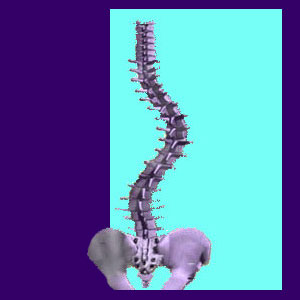
Scoliosis is an abnormal side-to-side curvature of the spine. A typical spine will have several curves that run from front to back, called lordotic and kyphotic curves. These are needed to maintain load bearing ability and distribute force throughout the vertebral column. However, when viewed from the direct back or front, a typical spine will appear perfectly straight side to side. Meanwhile a scoliotic spine will deviate from this straight ideal.
Side to side curvature of the backbone can lessen its ability to do what it is designed for, including performing physical tasks, distributing anatomical stress and maintaining symmetry throughout the body. An uneven spine can cause muscular issues and neurological deficits in severe and extreme cases. Luckily, most cases of side to side curvatures are minor and are not the source of any significant effects or pain. Abnormal side to side cures can also increase the chances of a person suffering the rotation of individual vertebra in the spine, which can also be problematic unto itself.
This resource section profiles a variety of side-to-side spinal curvature topics and provides a complete view of the mind and body consequences of suffering from scoliotic conditions.
Scoliosis Spinal Curvature Facts
Curvature of the spine is measured in degrees, just like an angle. A normal spine is straight or has a slight curve of less than 10 degrees. Mild curvature ranges from 10 to 20 degrees. Moderate curvature ranges from 20 to 50 degrees. Severe spinal curvature is measured at over 50 degrees.
Mild to moderate curvatures are rarely cause for alarm and most do not require more than regular monitoring by professional care providers. Serious, degenerative and extreme cases of side to side curvature may require conservative bracing or even some of the most invasive and risky back surgery techniques possible.
Please take the time to read about and consider the psychology of spinal curvature, especially if dealing with the condition in children and teens. The emotional effects of the condition can not only be worse than the physical, but under certain circumstances can actually be the root source of anatomical pain. Some patients suffer more from the feelings of being different and the perception that they are damaged goods, far more than the actual bodily issues involved in the curvature itself.

Scoliosis Spinal Curve Topics
Scoliotic curves are not necessarily health problems which require treatment. Many conditions are mild and should simply be monitored. Learn more about various aspects of side-to-side spinal curvature with these topical studies:
Curvature of the spine is normal from front-to-back, but is atypical when expressed side-to-side.
Spinal curvature pain can come from nerve compression or mechanical interactions.
Spinal curvature symptoms can go far beyond pain to include widespread nerve issues and physical disability.
Spinal curvature diagnosis is usually theorized by visual exam and confirmed via diagnostic imaging.
Spinal curvature treatment can consist of many different approaches to care, including the implementation of brace therapy, the recommendation to perform specialized spinal curvature exercises, the use of adjustments featured in spinal curvature chiropractic or the risky path of spinal curvature surgery.
Spinal curvature specialists might come from many healthcare backgrounds, including orthopedics, physical therapy, neurology and chiropractic.
Remember to learn all the pertinent spinal curvature facts before agreeing to a particular type of scoliosis therapy routine.
Varieties of Scoliosis
Idiopathic spinal curves are the most common forms of spinal curvature. They usually start in children in the pre-pubescent years, with the ages of 10 to 12 being the most common. The condition can also begin in younger children and sometimes in early teens. This variety is also known as adolescent spinal curvature.
Juvenile spinal curves can be very serious since they occur in very young children and typically require aggressive treatment.
Adult spinal curves usually occur in mature adults. They are most common past middle age and directly related to degenerative changes in the spine.
Congenital spinal curvature is a birth defect which develops when the child is still a fetus. These cases can be mild, but are unfortunately often some of the worst possible, causing widespread functional issues and possibly complete physical disability.
Other Types of Spinal Curvature
There are other spinal conditions that cause abnormal spinal curvature front to back, as opposed to side to side. These conditions are variants of the typical front to back curvature and entail either too much or too little curvature.
Lordosis is the normal type of curvature in the lumbar and cervical levels of the backbone. However, exaggerated or reduced lordotic change may be deemed pathological in some instances.
Kyphosis is the usual form of curvature demonstrated in the thoracic and sacrococcygeal levels of the spine. Once again, increased or reduced degrees of kyphotic change may be deemed pathological in some cases.
Scoliosis Facts
The curved spine will follow a definite shape. Most curves are either shaped like the letter C or the letter S.
Spinal curvature can exist almost anywhere. Most cases occur in the middle back (thoracic curve), the lower back, (lumbar curve) or the area where the 2 regions meet (thoracolumbar curve). The most common form of curve occurs in the thoracic area. Rarely do irregular side to side curvatures exist in the cervical spine.
Scoliosis is not an inherently painful condition. Normally, no pain or discomfort is reported in over 90% of mild to moderate cases. Some patients have extreme curves but do not feel any discomfort for long periods of time.
The problem with serious curves is far more than possible pain inducement, however. When the spine curves abnormally, the vertebrae do not align properly, setting the stage for the existence of central spinal stenosis or the formation of pinched nerves, since the foraminal spaces will likely be decreased on the side facing the interior of the curve. In some cases, internal organs can also be affected, usually being compressed by a rib. When this occurs to some structures, such as a lung, the consequences can be dire.
Read more about back pain related to spinal curvature.
Remember that neck pain from scoliotic curvatures can also occur, even when the curve is not directly located in the cervical spinal anatomy.
We suggest that all patients who are affected by atypical spinal curvature read Scoliosis-Pain.Com. This website provides easy to understand facts about scoliosis, including its causes, symptomatic expressions, diagnostic evaluation and optimal treatment options.

Scoliosis Advice
Mild to moderate spinal curvature is usually harmless and should not be a cause for concern. Make sure to consider the psychological impact of this condition on a child. A child who thinks there is something wrong with them will most likely suffer pain. This pain will not usually appear in a reassured child.
I always advise doing a particularly large amount of research about the specific type of scoliosis you have been diagnosed with and talking to more than one doctor. There are still wide ranging discrepancies in the way the condition is managed from practitioner to practitioner and the results of treatment vary greatly.
This is a condition which benefits from knowledge, so put in your due diligence and learn all you can. Do not rush into treatment without forethought and at least 2 professional opinions for best statistical results.
Our peer-acclaimed Cure Back Pain Forever can not change an abnormal spinal curvature, but it can help prevent, manage and cure pain associated with scoliosis.