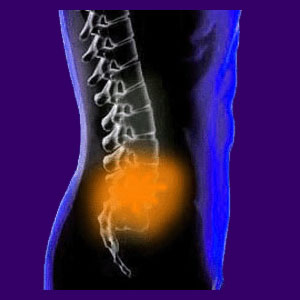
A herniated lumbar disc is the most common of all diagnosed disc pathologies. Specifically, the L4/L5 and L5/S1 discs are the typical problem spots in most spines. The lower back has been vilified by the medical back pain industry as an anatomical region fraught with degenerative conditions and predisposition for injury. In reality, the low back area is very strong and more than capable of performing all the normal tasks we require of it throughout our lifetimes. That being said, the lumbar spine is certainly affected by many degenerative processes and is also the site of a great number of back injuries.
Fortunately, the vast majority of disc protrusions in the low back are not symptomatic and should not cause any health issues whatsoever. Too bad this is not an absolute rule, since some disc conditions may produce mild, moderate or even terrible symptomatic expressions.
The scope of this article delves into the common mistaken implication of lumbar discs as the source of pain, when there is little clinical evidence to support said theory. Furthermore, the article will explore why some treatments actually seem to help, despite no logical efficacy imparted to the suspect disc.
Herniated Lumbar Disc Conditions
The lower back is prone to developing early lumbar degenerative disc disease, as well as herniated discs. This is a fact. However, there is considerable proof which demonstrates that herniated discs rarely cause perennial pain. In fact, most will not cause any pain. Additionally, the majority of all actual disc pain conditions will resolve without any medical treatment in a matter of weeks.
DDD is not actually a disease at all, but a completely normal and expected part of the aging process. Degenerative disc disease is a contributor to the development of herniations, but simply goes to prove that intervertebral bulges and ruptures are also normal occurrences and are rarely symptomatic.
All of these facts received professional verification recently, when diagnostic guidelines for back and neck pain were publicly revised by a number of prominent medical associations.
Lower Back Herniated Disc Treatments
There are probably more therapy options for herniated discs in the lower back than for any other spinal condition. 95% of these treatments are symptomatic in nature and most do not even make sense, given the nature of the diagnosis. Some of these therapies treat pain mostly due to placebo effect or by some secondary benefit of the actual treatment regimen.
For example, many therapies, such as heat or exercise, work moderately well for suspected disc pain. However, the heat or exercise do nothing to rebuild or repair the damaged disc. They do however, increase local oxygenation of affected tissue, temporarily relieving pain and associated symptoms. Why would adding oxygen help to relieve pain that is caused by a lumbar herniated disc? The answer to that question is easy.
Herniated Lumbar Disc Scapegoat
Herniated discs are the most commonly diagnosed of all back pain scapegoat conditions. Like many other spinal abnormalities, disc irregularities are commonplace and usually blamed for idiopathic back pain when no other obvious cause can be found. The reality of disc herniations shows that they are often found in the general population, but are mostly asymptomatic and often undiscovered. Only a small percentage of patients with herniated discs actually suffer any symptoms and in these circumstances, the disc condition is often coincidental to the pain. The most common actual cause of back pain in these patients is ischemia.
Oxygen deprivation back pain can be the result of a physical condition, but is far more often the enforcer for some psychosomatic back pain syndrome. If you experience mild to moderate symptomatic relief from a treatment modality which increases cellular oxygenation, there is a good chance that your disc pain has been grossly misdiagnosed. Sure the disc abnormality exists; there is no denying that… However, the herniation may be innocent and not the source of any symptoms at all.

Herniated Lumbar Spinal Disc Help
This topic is particularly close to my heart since I was diagnosed with herniated discs at L4/L5 and L5/S1 in my early 20’s. The former herniation got worse with time and the latter eventually ruptured. I also was diagnosed with degenerative disc disease at these and other lumbar spinal levels.
I was devastated by the severity of the diagnosis and received a considerable nocebo effect which definitely contributed to the worsening and perpetuation of my symptoms. I endured unbelievable back pain and sciatica for 18 long years. During this time, I gained insight to the true meaning of the words human suffering.
I hate to see any patient suffer at all, but it truly bothers my heart most to see a patient suffering needlessly. Learn the facts about herniated discs for yourself. Read the studies. There is nothing holding you back except yourself and the misinformation you have been force-fed by some uninformed source. You can get better, possibly without any treatment at all.
Don’t you want to be free from the pain?
I think that is an obvious question which requires no answer.
Learn more about ischemia and how it may just be the true underlying reason for your low back ache all this time.