
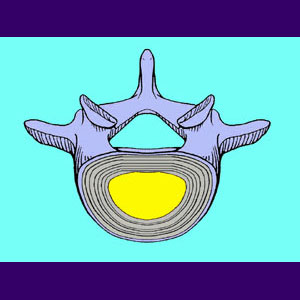
The annulus fibrosus is the outer wall of an intervertebral disc. This disc wall is composed primarily of collagen and fibrocartilage. The outer disc structure is actually made up of numerous layers of organic material which crisscross each other at angles for increased tensile strength. The outer spinal disc wall is very strong, but still maintains natural flexibility.
Inside the tough outer wall lies the core of the intervertebral disc, called the nucleus pulposus.
This article profiles the protective encapsulating outer wall of the intervertebral disc structure.
Annulus Fibrosus Disci Intervertebralis
Annular refers to layered rings which make up the structure of the outer disc wall. This is the same terminology used to describe the concentric rings found inside the cross section of a tree.
Although the layers of the disc wall are strong, they are still very prone to development of bulges or rips. A compromised, but intact, outer disc wall is called by a number of names, including: bulging disc, slipped disc or herniated disc. While some practitioners make distinctions between these terms, most back doctors use the names interchangeably. All describe the condition of the inner disc nucleus pressing forcibly into the outer wall, causing a deformity.
An annular tear describes a condition when the disc wall develops a rip or hole. This condition is commonly called a ruptured disc. In this instance, the nucleus actually bleeds partially or completely out of the disc. When the nucleus migrates out of the disc, this is called an extrusion. When the migratory piece of nucleus actually separates completely from the disc structure, this is called a sequestration.

Spinal Disc Facts
A compromised outer disc wall will create asymmetry in the disc and enact a shift in the internal disc nucleus. This asymmetrical condition can affect the circumference of the disc or the height of the disc, and typically affects both measurements.
Bulges are common and are found in a great percentage of the adult population. Ruptured discs are less common, but are still found in many adults.
Most minor disc conditions affecting the outer wall are not problematic or symptomatic in any way. Despite the fearsome reputation of herniated discs, most do not cause any pain and are often not even discovered, since there are no symptoms necessitating diagnosis.
Annulus Fibrosus Summation
Some herniated and ruptured discs can cause pain by compressing the spinal cord through a process called spinal stenosis. Compression of one or more of the spinal nerve roots is also possible as a symptom generator when foraminal stenosis occurs.
Many disc pain syndromes are misdiagnosed, which explains their treatment-resistant reputation. Actual disc pain conditions typically respond well to appropriate medical treatment and even nonsurgical modalities, such as spinal decompression, have worked wonderfully for many patients with severe symptoms.
Best of all, back surgery is virtually never needed to resolve disc pain.
Remember that some disc problems will heal all by themselves, even without any treatment. I am still walking around without any pain for many years now with a total of 12 herniated discs in my spine.