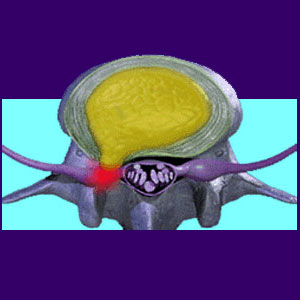
Millions of patients are searching for a herniated disc cure. Unfortunately, few ever find one and even more unfortunately, few even require one. Herniated discs are common in the general population. They can cause symptoms, but rarely are they the cause of the ongoing treatment-resistant back pain often associated with this relatively normal spine condition.
This discussion focuses on treatments used to cure pain that is linked to intervertebral herniations. However, we will also examine the shortcomings of many of these therapy options and explain why most spinal disc care methods fail miserably.
Traditional Herniated Disc Cure
Most conservative medical and alternative therapies for herniated disc pain relief are symptomatic treatments. Either the disc will heal on its own or more drastic treatment will be required. The only proven medical cures for disc injuries are herniated disc surgery and spinal decompression. Unfortunately, surgery can be risky and may leave the postoperative patient in worse condition. Staying clear of the risks of back operations is deemed prudent by many patients, so these people often choose a nonsurgical method, such as spinal decompression.
Of course both of these treatments can also act as a placebo cure, but the pain is likely to come back in a new location or as some other variety of back pain substitute symptom.
Mindbody Herniated Disc Cure
The reason that some patients are not satisfied with the results of their medical treatments for a herniated disc condition is that the disc injury is coincidental to the pain. That’s right, the disc is herniated, but that is not the actual cause of the discomfort. This fact has been proven by countless studies that failed to demonstrate any relationship between back pain and the occurrence of disc abnormalities.
This describes my exact spinal condition in the earlier years of my back ache journey. I have herniations at spinal levels L4/L5 and L5/S1 that were blamed for my chronic back pain for 18 years. Despite all my attempts to cure the pain, it remained and steadily worsened.
After many years, I realized that these symptoms were not generated from the discs at all. Instead, they were an expression of the mindbody process, with the lumbar herniations being completely coincidental. Once I determined the true nature of my pain, I managed to treat it myself using knowledge therapy techniques. Let me tell you something: Reading and learning sure beat surgery any day, especially when they can effectively relieve some types of pain instead of causing scars and possible disability!
Over the many years of providing patient education and advocacy services, I have rarely met anyone who was completely cured using any medical modality of care aimed at a herniated disc. I have met many people who enjoyed temporary respite from pain via surgery or some conservative method of care, but in virtually all cases, the misery returned, often worse than before. However, I have seen many “cures” offered by knowledge therapy, which is ironic, since the treatment does not actually cure anything physically. It merely resolves the internal reasons why pain exists and therefore stops the symptoms from ever occurring again. This is as close to a herniated disc cure as I have ever witnessed.

Tips on Finding a Cure for Herniated Disc Pain
Recently, I was discussing disc pain with a friend. She swore that she had read “the majority of my website” and understood all my concepts. Well, I listened to her story and noted her struggles as she detailed what seemed to me to be a classic case of stress-induced dorsal symptoms.
She mentioned that her single herniation at L5/S1 was tiny and not affecting any nerve tissue. She asked if her unresolved pain could possibly be psychosomatic. She was furious at the answer (as ambiguous and noncommittal as it was!) and was sure that somehow had I insulted her by doubting the physical nature of her pain. I get this reaction occasionally, but less now than before, since people are finally waking up to the mind’s ability to cause chaos in our physical bodies. Anyway, I do have a point to this story…
People love to learn about new things, but they have trouble applying the knowledge to themselves. There is still a sizeable stigma associated with psychological back pain. I find it almost humorous, since it is now a known scientific statistic that many cases of chronic pain have a definitive emotional component.
This patient did not want to find a cure. She wanted to find a new back pain treatment. She was content to allow the pain to ravage her time and time again. Some people just can’t be reached or helped. For the rest of you, here is your chance to open your mind to what might just amount to a real cure. Learn it. Use it. There is nothing to lose. If you have unrelenting pain that has not responded well to medical treatments, I can assure you that there is still hope. Learn more about knowledge therapy and even consider contacting some of the mindbody medical practitioners who have written so much in their literary lessons.