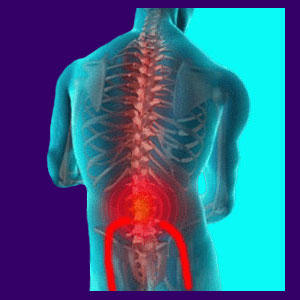
Sciatica is a general term used to describe radiating pain, and other neurological symptoms, in the buttocks and legs, usually caused by a nerve problem in the lower spinal regions. Sciatic nerve pain is often felt in combination with lower back pain, but may exist alone or in tandem with other types of dorsalgia. The sciatic nerve, also called the ischiatic nerve, is the largest and longest nerve in the body. Bilateral branches run down both legs and break up to form the peripheral nerve system serving the sensory and motor functions of the buttocks, legs and feet.
True sciatic nerve pain comes for a structural source in the spine, although pseudosciatica can mimic the painful expression perfectly even though it may be sourced from a nonspinal or even completely nonstructural causation. To further confound matters, although most patients and doctors alike associate sciatic nerve issues with the lumbar or lumbosacral spinal regions, it is completely possible for structural issues in the thoracic or cervical regions to also cause this agonizing set of symptoms. This is most often seen in patients with cervical spinal stenosis. As if things were not complicated enough.
This resource section provides complete coverage of symptoms related to a sciatic nerve source.
Pinched Sciatic Nerve?
A common misconception about lower body radiculopathy is that something in the spine is pinching the sciatic nerve. This is anatomically impossible, since the sciatic nerve does not actually ever meet the spine directly. Instead, nerve roots from the spine (L4, L5, S1, S2, S3) branch out and join up to form the sciatic nerve further down the body. It is the compression of one of these nerve roots that causes the symptomatic effects on the sciatic nerve. This condition is commonly referred to as a pinched nerve.
When a doctor tells a patient that they have a herniated disc pressing on their sciatic nerve, it really irritates me. Why not just explain how things really are, rather than oversimplify to the point of making your patient sound like an idiot? Tell them like it is; instead of treating them like children who can’t understand anything. Of course, the other possibility is that the doctor may not know this basic anatomical fact themselves. In this almost unthinkable case, they should surrender their medical license immediately and take up a far less cerebral profession.

Please learn more about the psychology of sciatic nerve pain and better understand the diversity of possible sciatic nerve pain remedies.
The actual medical diagnosis of sciatic pain is called radiculopathy. This diagnosis means that there is some problem in the spine, compressing one or more of the radicular nerve roots. These nerve roots eventually come together to form the sciatic nerve. Just for the record, sciatica can exist in one leg or in both legs.
Sciatic Nerve Pain Topics
Sciatic nerve pain is one of the most prevalent dorsopathy problems, affecting millions of patients. It is also one of the most chronic and difficult to resolve of all back and neck pain syndromes. Learn more about the condition and get on the path towards successful treatment:
Sciatic pain, technically known as sciatic nerve pain, is just one of many possible expressions of this epidemic back and leg syndrome. Additional sciatic symptoms include weakness, tingling and numbness, as well as other less common expressions. Chronic sciatic pain is the rule, with long-term expressions haunting most patients for years.
Sciatic back pain can come from the same origins that cause radicular pain in the legs. Localized pain is possible with many of the lumbar sources of sciatic nerve symptoms.
The potential causes of sciatic pain vary, but true versions will always have a structural component in the lumbar spine.
The diagnosis of sciatic pain is a serious problem, since the condition refers to a symptom set and never a separate diagnosis unto itself.
Sciatic nerve treatment can be accomplished using medical or complementary methods of care. No single modality provides the ideal path towards achieving sciatic nerve relief. Instead, sciatica treatment must be matched to the source of symptoms, which can vary significantly from patient to patient.
Sciatic surgery is commonplace, especially when symptoms do not resolve with more conservative care practices.
Sciatic therapy should not be taken lightly, since the industry demonstrates terrible results for creating lasting positive outcomes. Instead, patients should spend more time on proper diagnosis, rather than rushing forward into treatment.
Paresthesia in the legs is often part of a sciatica syndrome, but may exist for other reasons, as well.
For detailed information on sciatic nerve pain, please visit our sciatica encyclopedia on The Cure Back Pain Network. This web resource has been credited with providing cures for countless people around the world.
Sciatica or Not?
True sciatic nerve syndrome is sourced from a spinal causation. However, there are other reasons for the sciatic nerve to experience pain and functional loss.
There are 2 main conditions often mistaken for true sciatic nerve pain, since their symptoms can be very similar. These are piriformis syndrome and sacroiliac pain.
Sciatic nerve issues are often sourced by regional ischemia. This oxygen deprivation process makes perfect sense in explaining the variable and ever-changing symptomatic condition suffered by many patients. Keep this in mind if you have not been able to find relief from traditional care.
There are many myths surrounding lower body radicular pain. This is why I always advise patients to learn the sciatic nerve facts.

Experience with Sciatica Pain
I suffered from sciatic lower back pain for many years. The sciatica pain symptoms got worse as I got older. It got to the point where my legs were tired, painful and weak most of the time. The only chance I had to be free of the sciatic pain symptoms, was when they were eclipsed by acute lower back pain. Sometimes my lower back pain was so severe, it actually completely overpowered the nagging sciatic nerve symptoms. The 2 problems working together made me a miserable person and made me fear for my future.
In closing, it is vital to know that sciatica is a set of symptoms. It is not and never a diagnosis unto itself. If your doctor pronounces: “You have sciatica”, tell them: “Yeah, thanks for telling me something I already know. Now, what is causing it?” Watch the surprise on their face. It may make you smile for a moment, before the pain comes back to turn that happy face into a frown. Ouch.
Do you want to end sciatica for good? Our proven Cure Back Pain Forever Program provides the very best results and is 100% safe to use for all diagnoses.