Non-surgical spinal decompression is an interesting conservative therapy option for many patients with particular types of back pain. Recently, there has been much discussion about the effectiveness of decompression therapy and some controversy involving many of the major names in the industry. This debate has caused many patients to reconsider decompression treatment due to citations they have read or heard from their doctors.
The purpose of this article is certainly not to defend or condemn the spinal decompression sector, but instead to provide some insights which should be considered by any patient thinking about undergoing this noninvasive back and neck pain treatment option. Remember that we always thoroughly investigate the research statistics associated with any treatment before reporting on it. However, just as important are the actual patient experiences you send to us each and every week regarding your own results using various spinal treatments.
We hope this article helps to answer many of your questions concerning the efficacy and safety of spinal decompression.
Non-Surgical Spinal Decompression Details
First off, spinal decompression is not for everyone. It is best indicated for patients theorized to have back pain symptoms due to degenerative disc disease, certain types of contained herniated discs and certain types of spinal arthritic processes. In our experience, it seems to work best for disc pathologies, particularly those typical disc bulges which fit the profile demonstrated by most patients.
Decompression involves gently and precisely stretching particular spinal segments in order to relieve pressure on neurological tissues, often called compressive neuropathies. It can also work to relieve disc pressure on the central spinal canal, often referred to as central spinal stenosis.
Nonsurgical decompression can also be used for treating facet joint syndrome, but in our experience, offers less reliable results for this application.

Non-Surgical Spinal Decompression Opinions
Decompression therapy has proven itself to be a great option for many dorsopathy patients due to the following reasons:
Decompression is effective for providing long-term relief for some types of structurally motivated pain, particularly those syndromes enacted by verifiable disc concerns with verifiable neurological impairments.
Decompression offers the chance for patients to avoid spinal surgery.
The treatment is quite intense and expensive, therefore, even when the patient is misdiagnosed and misguided as to the actual source of pain, there is a very good chance for a placebo cure. If a placebo is to be the result, it is far better to come from a nonsurgical method than risk the horrors of back surgery to enact it!
Much of the controversy about decompression therapy has been stirred up by spinal surgeons who are obviously losing customers to this noninvasive option. In our opinion, tough luck, you already spent decades butchering patients, mostly unnecessarily.
Decompression is growing as a choice for disc pain treatment, bringing prices down for many patients.
There is little risk of injury compared to many other forms of back care.
Noninvasive Spinal Decompression Factsheet
Having heard lots of negativity about the various nonsurgical decompression therapies recently, we thought it best to offer a more balanced viewpoint. We still feel that many patients who undertake the treatment do so without need, since their pain is not likely to be sourced by the common and sometimes universal spinal issues implicated in the (mis)diagnosis. However, we would rather see them try decompression than to face the inherent injury and likely risk of complications associated with spinal operations.
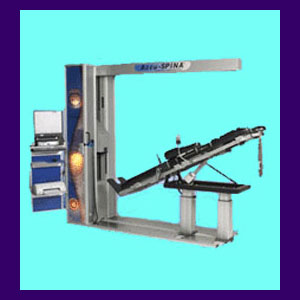
To learn more about spinal decompression, contact a care provider from one of the more popular forms including DRX9000, AccuSpina, Antalgic-Trak and Vax-D.
As a final note, it must be mentioned that most of the indicated conditions for treatment are the very same which are usually mistakenly implicated as sources of pain. In many cases, these disc and bone issues may be completely innocent and may not require any treatment at all.
Back Pain > Spinal Decompression > Non-Surgical Spinal Decompression